







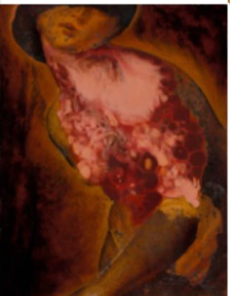


Uneven Ground Juggling, 2024
2024
Oil on Trani (stone)
30 × 20 cm
30 × 20 cm
Artist
Nicola Samorì (ITA)
Nicola Samorì (ITA)
Nicola Samorì (b. 1977, Forlì, Italy) is one of the most prominent painting and sculpture artists in contemporary Europe. He graduated from the Academy of Fine Arts in Bologna in the late 1990s and has since held solo and group exhibitions throughout Italy and internationally, including multiple appearances at the Venice Biennale.
Deeply influenced by 16th- and 17th-century Baroque and Renaissance painting, Samorì often begins with Old Master–style compositions, lighting, and flesh tones, meticulously rendering a classical-looking portrait or body on canvas, wood, copper, or stone. He then subjects the image to forceful physical interventions—scraping, tearing, dissolving, or covering—“destroying” the very surface he has just created.
This continual movement between depiction and erasure generates an intense theatricality: ideal bodies and smooth skin corrode, collapse, or slide into abstract masses of color, exposing the underlying paint layers and support, as if the image itself were undergoing the erosion of time and memory.
Through this process, Samorì constructs a visual language suspended between the classical and the contemporary: on the one hand, extending the sacred atmosphere and dramatic tension of religious and historical painting; on the other, using violent image manipulation to question traditional modes of representation and to reveal the irreconcilable tension between beauty and destruction, image and material.
Deeply influenced by 16th- and 17th-century Baroque and Renaissance painting, Samorì often begins with Old Master–style compositions, lighting, and flesh tones, meticulously rendering a classical-looking portrait or body on canvas, wood, copper, or stone. He then subjects the image to forceful physical interventions—scraping, tearing, dissolving, or covering—“destroying” the very surface he has just created.
This continual movement between depiction and erasure generates an intense theatricality: ideal bodies and smooth skin corrode, collapse, or slide into abstract masses of color, exposing the underlying paint layers and support, as if the image itself were undergoing the erosion of time and memory.
Through this process, Samorì constructs a visual language suspended between the classical and the contemporary: on the one hand, extending the sacred atmosphere and dramatic tension of religious and historical painting; on the other, using violent image manipulation to question traditional modes of representation and to reveal the irreconcilable tension between beauty and destruction, image and material.